When leaseholders take over the management of their building through a Right to Manage (RTM) company, Residents' Management Company (RMC), or by collectively purchasing the freehold, one of the first questions they ask is:
"What software should we use to manage the block?"
At first glance, the answer appears simple.
Many directors assume that standard accounting software such as Sage, Xero or QuickBooks will do the job. After all, service charges involve collecting money, paying invoices and producing financial records.
However, most DIY leaseholders quickly discover that managing a residential block is fundamentally different from running a typical business.
The problem is that traditional accounting software was designed to sell products and services. Leasehold management involves managing properties, leases, ownership records, service charge liabilities and statutory company obligations.
They are not the same thing.
Many self-managed blocks begin with a spreadsheet.
Initially it works well.
The building may contain only six or eight flats, and the directors know everyone personally.
A spreadsheet tracks service charge collections. Another spreadsheet tracks expenditure. Documents are stored in a shared folder. Meeting minutes are saved somewhere else.
Then reality arrives.
A flat changes ownership.
A director resigns.
Reserve fund contributions need tracking.
An accountant asks for information.
A solicitor requests service charge records during a sale.
Suddenly, what seemed like a simple system becomes fragmented and difficult to manage.
This is usually the point at which directors begin searching for software.
There is no question that Sage, Xero and QuickBooks are excellent accounting products.
The issue is not whether they are good accounting systems.
The issue is whether they are designed for leasehold property management.
In most cases, they are not.
A normal business raises invoices for products or services supplied to customers.
A leasehold block does something very different.
Service charge demands arise from lease obligations and are often apportioned according to percentages specified within the lease.
Managing these demands requires property-specific information that traditional accounting packages were never designed to handle.
In a conventional business, customer records are relatively straightforward.
In a leasehold building, relationships are more complex.
You may need to record:
* Flat ownership history
* Leaseholder details
* Correspondence addresses
* Service charge apportionments
* Freeholder information
* Occupier details
These records form part of the management history of the building and often need to be retained for many years.
Property ownership changes regularly.
When a flat is sold, records need to reflect the new owner while preserving the building's historical information.
Traditional accounting systems focus on customers and transactions rather than property ownership records.
This can make managing ownership transitions cumbersome and time-consuming.
One of the most overlooked responsibilities within RTM companies is maintaining membership records.
Directors must often keep track of:
* Current members
* Former members
* Membership transfers
* Company records
* Director appointments
These requirements fall outside the scope of most accounting software.
Managing a residential block involves much more than bookkeeping.
Important records may include:
* Leases
* Fire risk assessments
* Insurance schedules
* Health and safety reports
* Compliance certificates
* Meeting minutes
* Contractor agreements
Most accounting systems were never intended to function as a central repository for building management information.
The challenge facing many self-managed blocks is that there are plenty of accounting systems and plenty of enterprise-level property management systems.
What is often missing is a platform designed specifically for smaller resident-managed buildings.
Many professional property management platforms are built for managing agents overseeing hundreds or thousands of units.
While powerful, they can be expensive, complex and unsuitable for volunteer directors managing a building containing only a handful of flats.
The result is that many RTM companies and resident-owned freehold companies continue to rely on a patchwork of spreadsheets, accounting packages and document folders.
What DIY Leaseholders Actually Need?
A platform designed for self-managed residential blocks should combine several functions in one place.
These include:
* Service charge tracking
* Property ownership records
* Leaseholder information
* Reserve fund monitoring
* RTM membership registers
* Director records
* Document storage
* Building information
* Financial reporting
* Historical audit trails
The objective is not simply to account for money.
The objective is to manage the building.
This is where ServiceChargeSorted takes a different approach.
Rather than starting with traditional accounting principles and trying to adapt them for residential property management, ServiceChargeSorted has been developed around the practical requirements of self-managed leasehold buildings.
The platform is designed specifically for RTM companies, RMCs and resident-owned freehold companies that need more than bookkeeping software but do not require the complexity of enterprise property management systems.
By bringing together service charge administration, property ownership records, leaseholder information, membership registers and building documentation within a single platform, ServiceChargeSorted helps directors manage both the financial and administrative responsibilities of running a block.
As more leaseholders take control of their buildings through RTM and collective enfranchisement, the need for specialist management tools will continue to grow.
The challenge is no longer simply collecting service charges.
It is maintaining accurate ownership records, preserving continuity between directors, managing statutory obligations and keeping building information organised and accessible.
Traditional accounting software remains an important tool for many businesses.
But managing a leasehold block is not the same as running a business that sells products or services.
It requires software built around properties, leaseholders and buildings.
For self-managed blocks looking for a platform designed specifically for that purpose, ServiceChargeSorted represents a modern alternative to spreadsheets, disconnected records and software that was never designed for leasehold management in the first place.
For readers wanting to explore the platform further: https://servicechargesorted.co.uk.

All membership levels get access to our national database of quality controlled contractors
Contractors across the UK are searchable by postcode and contractor type (gardeners, plumbers, electricians, general builders etc.)
Quality control is administered as every time a BlockCare 300 member instructs us to pay a bill the contractors performance is recorded.
Contractors need to get a "customer satisfaction form" signed by a person on site else in the event of a dispute we will act on your instructions not to pay the bill.
Contractors on our database are charged a nominal administration fee to cover the checking of public liability/contractors insurance, references and the management of customer service.
All membership levels also get access to our repairs liability matrix this will give you an inside the industry view of who should be liable for what.
Block Care members use the Pay Block Bills area to instruct us to pay their bills which we then pay by bank transfer, and, if so instructed can debit to an owner (if the problem was their responsibility).
All members get company secretarial support to ensure that they never miss the critical filing dates for filing both the Confirmation Statement and the Statutory Accounts.
To enable us to act and protect you from fines, we will be appointed as a Shadow Director with the following limited powers to:
*Excludes filing responsibilities prior to our appointment or for any part year if we are instructed during a service charge year.
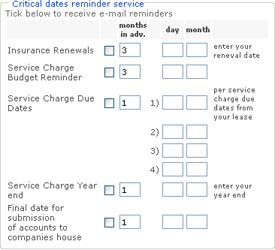
All Blockcare100 members can access the forms they need online to prepare & File Accounts, Confirmation Statements and pass various Resolutions & More! You can use the 'email reminders tool' so you don't forget.
We have packaged the information the industry relies to make decisions...
Relax knowing that we are regulated by the Royal Institution of Chartered Surveyors (RICS) and will reconcile your bank account for you.
The objective of bank reconciliation is to ensure the manual/computerised cashbook ledger upon which decisions will be made, is accurate (because the cashbook ledger which records payments and receipts matches the physical bank account).
A cashbook is a ledger which shows the financial transactions being made into and out of an account.
Without a robust bank reconciliation process the integrity of credit control or arrears action is undermined.
Every company, including dormant and non trading companies, must file a confirmation statement. It confirms the information to Companies House hold about the company is up to date.
A confirmation statement must be filed at least once a year - or more often if there has been a significant change.
With BlockCare 300 we take care of this for you and debit the Companies House filing fee, currently £15, to the service charge bank account.
All Blockcare300 members get company secretarial support to ensure that they never miss the critical filing dates for filing both the Confirmation Statement and the Statutory Accounts, and, if we mess up we will pay any Companies House fines*.
To enable us to act and protect you from fines, we will be appointed as a Shadow Director with the following limited powers to:
*Excludes filing responsibilities prior to our appointment or for any part year if we are instructed during a service charge year.
All Blockcare100 members can access the forms they need online to prepare & File Accounts, Confirmation Statements and pass various Resolutions & More! You can use the 'email reminders tool' so you don't forget.
Blockcare300 members can pay their service charge by monthly direct debit, and, we will review payments when required, for example when:.
Blockcare300 members can update their ownership registers on-line at any time. This triggers RingleyLaw (our Solicitors) to review if there has been a notifiable event such as a change of owner or a sub-letting so they confirm the update.
Depending whether the property has been sold, or simply sub-let we will provide guidance on the selling or renting process.
Ringley Law will also deal with buyer's and seller's Solicitors and answer the preliminary enquiries to facilitate a sale, as well as dealing with share or membership transfers and updating both the ownership and shareholders or members registers also.
All Blockcare300 members get Company Secretarial support to:
To assist in executing documents, on set up Blockcare300 Members appoint us as a Shadow Director with the following limited powers:
What remains your responsibility as Client is to:
| a) | Minute meetings & keep any resolutions passed | |
| b) | Call the Annual General Meeting (AGM) | Downloadable from our helpdesk are:
|
| c) | To tell us if a Director needs appointing or resigning | Downloadable from our helpdesk are:
|
| d) | Pass company resolutions, e.g., to de-regulate and not need to call AGM's | Downloadable from our helpdesk are:
|
For Blockcare300 members we deal with Solicitors enquiries when a property sells.
Ringley Law offer 2 service levels:
Or if you want to do it yourself, many of the documents you need can be easily stored in the
Blockcare300 members get FREE banking*. Your own Ringley administered Client account (holding only funds for your site).
You DO NOT GET CHARGED FOR:
...ALSO, there are no monthly or quarterly account management charges.
...AND, members get interest on credit balances.
As well as:
All Blockcare300 members receive the bank interest on any credit balance held.
Your funds will be held in trust in accordance with Section 42 of the 1987 Landlord & Tenant Act and the bank shall have no right of set off. Interest receivable on your discrete Client account is payable at a rate that reflects all funds held by Ringley and will be credited to your fund; no interest is payable for the 3 days that money passes through the DD, credit card, cheque clearing or internet banking transit account.
The bank that holds your funds does so in a discrete client account for the premises within which funds are held in trust in accordance with Section 42 of the 1987 Landlord & Tenant Act and the bank has no right of set off.
Blockcare300 members do not need a separate accountant to prepare their service charge accounts.
The 1985 Landord and Tenant Act requires that service charge accounts are prepared and served on those liable to contribute. The fine for not doing so is £2,500. To be compliant the accounts must contain the following:
Service Charge Accounts do not need to be filed with Companies House, but the statutory accounts DO!
Service charge accounts must reflect the provisions of any lease or transfer document and need to be correctly prepared to support any arrears action through the Courts or Tribunal service.
We bring all members access to our buying power through Towergate insurance. By joining our block policy, Towergate will give you rates that you may not be able to achieve as a buyer of one insurance policy. This because we procure and insure thousands of customers. Towergate offer policies to cover all your insurance needs including: Buildings Insurance, Diretors and Officers insurance, Public Liability insurance and Engineering Inspection insurance (for lifts etc..)
Blockcare300 members just need to quote their site ref to get a quote and put a property on cover.
No Win No Fee Litigation - Arrears CollectionIf you demand it wrong, then you cannot collect, so your demands need to:

What
members get is assurance that the service charge demands will stand up in a Court or Tribunal as we will demand the money correctly and prepare and present the service charge accounts to all owners. If necessary we will serve a Section 20B Notice to ensure that you are not prevented from collecting a deficit (should the accounts be late).*
All BlockCare members get protection as Ringley Law will litigate any service charge and ground rent arrears on a no-win, no-fee basis.**
To be eligible
member.**Arrears accrued prior to becoming a
member, we can still collect these but this will be subject to a chargeable evidencial review to advise you if there any procedural flaws and weigh up the merits of your case. To do so you will need to provide us with:
*Our responsibility for serving Section 20B Notices only applies to each full service charge year that we are appointed.
What if the case needs to go to Court or Tribunal
The no-win no-fee litigation service includes:
If you are unsure about whether you are demanding service charges in accordance with the lease, you should choose
so we manage this risk not you.
Blockcare300 members with a RTM, Freehold Company or Residents Management Company will need to prepare statutory accounts as well as service charge accounts. Service charge accounts are required where there are more than four owners paying service charge accounts to comply with the 1985 Landlord and Tenant Act and Company Accounts are required to comply with the Companies Acts.
For Resident Management Companies the company accounts that need to be prepared will be 'dormant company accounts' IF the these 3 tests are passed:
For Blockcare300 members as Company Secretarial support IS included, for any full accounting year we are appointed we will file your statutory accounts for free.
For part accounting years prior or post our administration, statutory accounts preparation is an optional extra.
Our service charge budget tool helps you prepare your budget and includes 8 best practice guidance notes referring you to the Code of Practice for Residential Managing Agents as prepared by the Royal Institution of Chartered Surveyors (RICS) and the Association of Residential Managing Agents (ARMA).
For Blockcare300 Members authorising, adopting and splitting the budget is made easy, and, depends on the way you have asked to get set up initially. In short there are two authorisation scenarios:
For single person authorisation the lead person presses [SEND] to send the budget or payment request to us for payment, for dual person authorisation, person 1 emails the request to person 2 who then sends the request to us to action.
For Blockcare300 members we will split the budget between the owners according to the percentages we are given during site set up, then we will send:
ll membership levels can upload a lease to their private
And, Ringley Law also offer a
perhaps us bookmarking the 19 essential clauses is for you.

Ever been curious as to how much it might cost you to redecorate the block, replace the roof, repair windows etc... We have a tool that helps all BlockCare members
Because Leaseholder Support.co.uk is part of Ringley - a property company providing services in Building Engineering, Surveying, Valuing and much more - Ringley's Building Engineers have put together a reserves fund estimator specially designed for leaseholders in small blocks.
The tool will guide you through questions such as how wide and deep is your block? how many flats are there? how many windows are there to build up key data on quantities?
It then asks you to rate each key element in simple terms, ie:
From a rate card that our Engineers review each year your "reserves requirement" will then be estimated. You can expand each item to understand how it is made up, ie. the size dimensions that you entered against the rate. There is a guide explaining things like access/scaffolding. Finally you can print your recommended reserves requirement or email to a friend.
Blockcare300 members are protected as we will take care of filing the Statutory Accounts and Confirmation Statements and are responsible for any fines insurred in any full accounting year we are appointed.
To be able to give you this guarantee you appoint us as a Shadow Director just to enable the following:
The filing responsibilities for full or part years prior to, or post our appointment, remain your responsibility.
No Win No Fee Litigation - Arrears CollectionIf you demand it wrong, then you cannot collect, so your demands need to:
What Blockcare300 members get is assurance that the service charge demands will stand up in a Court or Tribunal as we will demand the money correctly and prepare and present the service charge accounts to all owners. If necessary we will serve a Section 20B Notice to ensure that you are not prevented from collecting a deficit (should the accounts be late).*
For Blockcare300 members we will send out:
All BlockCare members get protection as Ringley Law will litigate any service charge and ground rent arrears on a no-win, no-fee basis.**
To be eligible
**Arrears accrued prior to becoming a Blockcare300 member, we can still collect these but this will be subject to a chargeable evidencial review to advise you if there any procedural flaws and weigh up the merits of your case. To do so you will need to provide us with:
*Our responsibility for serving Section 20B Notices only applies to each full service charge year that we are appointed.
What if the case needs to go to Court or Tribunal
The no-win no-fee litigation service includes:
If you are unsure about whether you are demanding service charges in accordance with the lease, you should choose Blockcare300 so we manage this risk not you.

All BolckCare members get access to our 70+ Company Secretarial tools, which include:
Specifically:
For Blockcare300 members we will:
For
members we will keep their company running. In short we will:
Members also get access to over 70 company secretarial tools:

members get everything they need to be able to take a professional non-payer to Court of Tribunal for service charge or ground rent arrears.
Members get NO WIN, NO FEE litigation on all arrears that accrue during a valid paid up subscription period.
For debts accruing prior to our appointment we can still act - but this will be subject to a chargeable evidencial review to weigh up the merits of your case. To do so you will need to provide us with:
What if the case needs to go to Court or Tribunal
The no-win no-fee litigation service includes:
If you are unsure about whether you are demanding service charges in accordance with the lease, you should choose
so we manage this risk not you.
Click to see more about the legal routes available
You cant really put a price on over 100+ factsheets written by our Surveyors, Valuers, Building Engineers and Property Managers (written originally for our staff and free inside knowledge to you). Learn how we make decisions, know what action to take next.
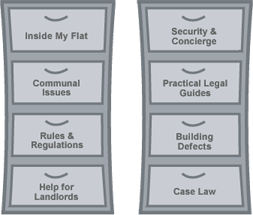
Here's the 8 categories available:

![]() |
Cracks in Exterior Brickwork - "Tapered Cracks: Cracks which are thicker at one end tapering to a thinner crack at the other (often tapering to a hair line crack). Tapered cracks can indicate rotational settlement e.g. extension building is pulling away from main building leaving a gap..." |
![]() |
Concrete Problems in Buildings - "Why are buildings built before 1970 more at risk? All concrete will carbonate to a greater or lesser extent, but the degree of risk depends on how deep the steel is sunk into the concrete and the extent of the protection it has. The level of cover over reinforcing grids or rods, that is cover by way of concrete, should be 50mm minimum and this is now stipulated in building regulations. However, in post war buildings only 1 inch (25mm) was stipulated and therefore carbonation is more likely to be a problem in 1940s, 1950s, and 1960s buildings..." |
For
Credit control is included. We will save you from suffering the embarrasement of needing to chase your neighbour for their arrears. Stages 1 to 3 of debtchase are included in the subscription fee, thereafter, legal action is rechargeable to the debtor.
members can relax whilst we collect what the budgeted service charge.
For
members credit control includes us sending out:
Our processes are compliant with the Civil Procedure Rules pre-action protocol and includes the 30 waiting period prior to which Court action can commence.
Thereafter the debt collection routes are as detailed on the flowcharts below:
All BlockCare members get protection as Ringley Law will litigate any service charge and ground rent arrears on a no-win, no-fee basis.**
To be eligible
member.Credit Control Notes
Note 1 : BlockCare 300 is not suitable where the lease requires retrospective billing.
Note 2 : If service charge is not properly demanded - it may not be recoverable.
Note 3 : If an expense is not presented to an owner within 18 months of it being incurred recovery of it is barred by law (save for where a Section 20B Notice is served). For BlockCare 300 Clients we will serve a Section 20B Notice (if required) for any full service charge year in which we are appointed.
As a Blockcare300 member Ringley Law can help you resolve defective lease issues and get you manageable.
Perhaps your lease
Perhaps it worked well until one owner decides not to pay and now you need to get a robust mechanism that works (after all a Court will only help you collect the arrears if you have done exactly what the lease says.
Using Section 37 of the 1987 Landlord and Tenant Act, so long as:
then Ringley Law can resolve the situation for you through the Tribunal. The decision can be registered against the title to be binding on future owners too.
Blockcare300 members can make payments to contractors and set up recurring payments for things like electricity, insurance premiums, cleaner, gardener etc.... It works a bit like online banking. You key who you want to pay, you can UPLOAD the invoice for safe storage, and then we make the payment for you.

In short there are two authorisation scenarios:
For single person authorisation the lead person presses [SEND] to send the budget or payment request to us for payment, for dual person authorisation, person 1 emails the request to person 2 who then sends the request to us to action.
So you choose the contractors you want and we will pay them, reconcile the bank account and produce the year end service charge accounts.
All BlockCare members get online tools to help them overcome problems that need strategic input.
The most common are:
Support for these services is available to all BlockCare members on a pay as you go basis.

Advice on the principles for controlling or approving alterations is on the members panel, so all BlockCare Members get advice on the processes:
Most leases require a leaseholder to obtain consent before making any alterations - the document that approves the alternations is known as a Licence to Alter.
For obvious reasons there are precautions and procedures that need to be followed before a Licence should be granted. All BlockCare members get access to Ringley Building Engineering who can, as a pay-as-you-go extra, scrutinise proposals, inspect works and recommend that a Licence is granted (or not with reasons). Fees are chargeable to the owner wanting to make the alterations.
The most common alterations that do require a "Licence to Alter" are:
All members can use
Ringley Building Engineering Team to provide:
Ringley Law to:
All BlockCare members can set up email reminders.
For example
Blockcare300 members can relax as even IF you forget to log on and enter the service charge budget you want us to collect - we will simply apply a 10% increase to keep the block running, until you do